

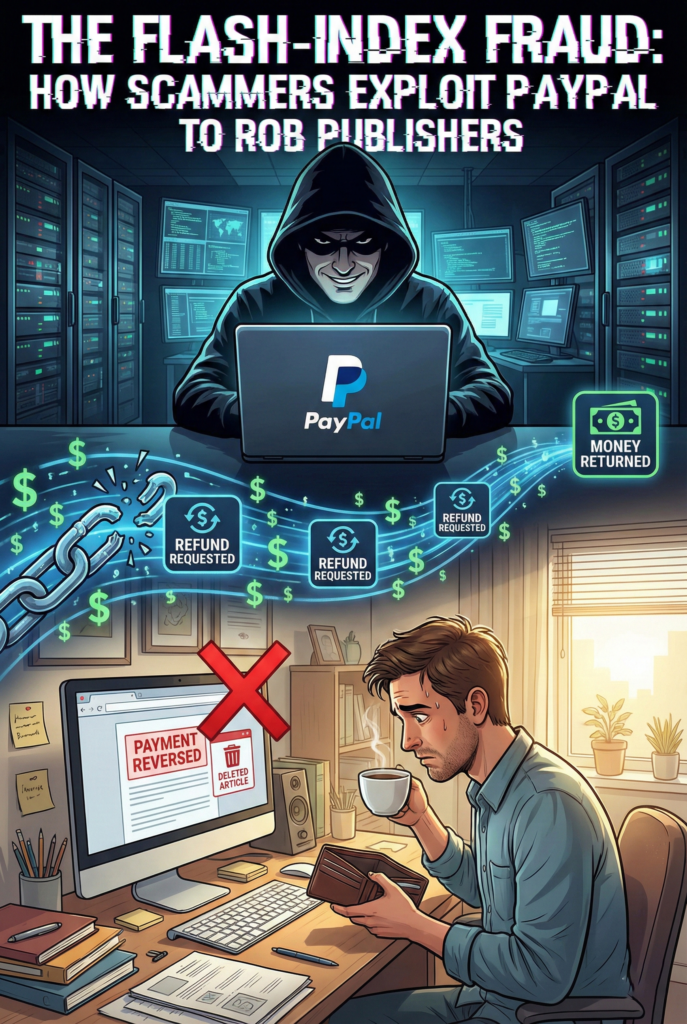
The “Flash-Index” Fraud: A Critical Warning for Digital Publishers
Warning: The rules of the game have changed. “Payment in advance” is no longer enough to protect your business.
Digital publishers and blog owners are facing a sophisticated new fraud scheme that exploits the gap between the lightning speed of modern internet infrastructure and the slow pace of financial bureaucracy. We are calling this the “Flash-Index” Scam.
If you run a blog, news site, or any digital publication that accepts sponsored content, you are a potential target. Here is how the scam works, why it is devastatingly effective, and how to stop it.
The Evolution of the Scam
The Old Way: “Pay After Publication”
The scam exists since the early days of digital marketing and in those days it was simple. A buyer would promise to pay for an article “once it goes live.”
The publisher would post the content, and the buyer would simply disappear without paying. Publishers quickly learned their lesson, and “No Pay, No Post” became the industry standard.
The New Way: The “Refund & Run”
Scammers have adapted. They realized that to get past your defenses, they need to pay you first. Here is the new, dangerous playbook:
- The Bait: A buyer approaches you with a professional article about a brand or product launch. They agree to your price immediately ($500–$900 is typical).
- The Hook: They pay upfront using a reversible method like PayPal or a credit card (via Stripe). You see the money in your account and feel safe.
- The Trigger: They pressure you for immediate publication, citing a “time-sensitive press release.”
- The Trap: You publish the article. Within 3 to 5 minutes, the scammer achieves their goal (global indexing).
- The Theft: 6 to 12 hours later, the scammer files a dispute (Chargeback) claiming “Item Not Received”, “Broken Item”, or “Unauthorized Transaction.”
PayPal and credit card processors notoriously favor the buyer in disputes involving digital goods. The funds are forcibly removed from your account. You delete the article in anger, thinking you have punished them, but you haven’t.
The Technical Reality – Why 5 Minutes is Enough
To understand why the scammer doesn’t care if you delete the article later, you must understand Entity Association.
The scammer isn’t looking for human readers to click the link. They are hunting for Algorithmic Validation. Once a piece of news is published on a reputable domain (like yours), a massive, automated chain reaction occurs instantly.
1. The Search Engine Crawl
High-authority sites are crawled incessantly. Within minutes of hitting “Publish,” the following bots index your content and the outbound link pointing to the scammer:
- Google (Google)
- Microsoft
- Bing
- MSN
- Yahoo
- DuckDuckGo
- Baidu
- Yandex
Google, the dominant search engine, has stated that high-authority sites can see new content indexed within seconds. Research from SEO professionals consistently shows that news sites and regularly updated blogs experience indexing times of under 3 minutes.
2. The New Aggregators Cache
If your site is recognized as a news source or included in news feeds, news aggregator platforms will pick up your content in seconds and distribute it across their platforms:
- Google News
- Apple News
- Microsoft News (MSN)
- Feedly
- Podcast
These aggregators actively monitor news sources and display new content within minutes of publication.
3. The Infrastructure Cache
Simultaneously, internet security and traffic infrastructure companies scan the new link to ensure it is safe. In doing so, they validate the relationship between your trusted domain and the scammer’s brand. This creates a “trust footprint” in the internet’s backbone via:
- Cloudflare (DNS & Security)
- Barracuda Networks
- Akamai Technologies
- Fastly (edge cloud platform)
- The Internet Archive (Wayback Machine)
These systems create snapshots, cache copies, and security scans that preserve content even after it’s deleted from the original source.
The Real Value – Reputation Signals and SEO Equity
Even if you delete the article after 5 minutes, the Signal has already been captured. Here’s what makes this scam worth tens of thousands of dollars for each article successfully “published” to the perpetrators:
1. Backlink Equity
Even temporary publication on a legitimate website creates valuable backlinks. While Google states that removed links eventually lose value, the “link juice” can benefit the scammer’s site for months before the search algorithm fully processes the removal.
2. Brand Reputation Signals
Search engines don’t just look at what exists now, they build historical profiles. When a brand is mentioned positively on credible websites, this creates “entity trust” signals that persist in search algorithms even after the source content is removed.
3. Cached Results
As mentioned, various systems cache web pages. Someone searching for the brand weeks after article removal might still find cached versions showing the brand on legitimate news sites.
4. Screenshot Evidence
Scammers often take screenshots of the published article to use in marketing materials, investor pitches, or to build credibility with potential partners. “As featured on BBC or CNN sites” carries weight, even if the article was only featured for two minutes.
5. Citation and Reference Trails
Other sites, social media accounts, and aggregators may reference or link to the article during its brief publication window, creating a reference trail that outlives the original content.
Industry experts estimate that a single well-placed article on a medium-authority website can generate $8,500-$17,000 worth of SEO and reputation value, even if only published for minutes. For high-authority news sites, this value can be much higher.
The “Signal” Effect
The Signal is permanent historical record in the algorithm that boosts the scammer’s SEO authority (helping them rank higher for their own keywords) for min 6 months, even if the original link returns a 404 error.
They bought a permanent reputation boost for free, using your site as the fuel.
How to Protect Yourself
The “Flash-Index” fraud relies on reversible payments.
Here is how you must adapt your business model.
1. Update Your Terms of Service (ToS)
Add a specific clause to your invoices. While this won’t stop a scammer, it helps you fight the dispute:
“Digital Publishing Service Agreement: The service is considered ‘delivered’ and ‘consumed’ the moment the URL is indexed by Google. No refunds are permitted after indexing. Any chargebacks will be contested with server logs proving delivery.”
2. Demand Irreversible Payments
For unverified clients, stop accepting Credit Cards or Standard PayPal. Switch to methods that cannot be clawed back:
- Wire Transfer (ACH/SWIFT/SEPA)
- Cryptocurrency (USDT/USDC/Bitcoin)
- Direct Bank Deposit
3. Implement a Holding Period
For new clients paying via PayPal, publish the article, but hide it from search engines for the first 3–7 days. You can do this by adding a simple meta tag to the header of that specific post:
<meta name="robots" content="noindex">This allows the client to see the live post (proving you did the work), but prevents Google from passing the “SEO Juice” until you are sure the payment won’t bounce.
Conclusion
The digital publishing landscape is an ecosystem of trust. Scammers are weaponizing that trust. Do not assume that deleting an article punishes a non-paying client. In the eyes of the algorithm, the endorsement has already happened.
Spread the word. Share this article with other blog owners and publishers. The only way to stop the Flash-Index scam is to make it unprofitable for the scammers to try.
Resources & Citations
- Federal Trade Commission (FTC): Scams and Your Small Business Guide.
The FTC warns small businesses about “fake client” scams and invoice fraud where scammers manipulate payment terms. - PayPal Legal Agreements: Seller Protection for Intangible Goods.
Review the “Intangible Goods” section carefully. PayPal often excludes services from protection unless strict “proof of access” is provided, which is difficult to prove for SEO articles. - Better Business Bureau (BBB): BBB Scam Tracker.
Search for “Fake Client” or “Overpayment Scams” to see thousands of reports of service providers being targeted by fraudulent buyers. - Google Search Central: Googlebot Crawl Rates.
Documentation confirming how quickly high-quality sites are indexed (often within minutes), validating the speed of this scam. - MOZ Flash Index Scam: Moz: Off-Site SEO & Brand Signals – Explanation of how flash index scam works and brand mentions create value.